
taekwondo forms 1-8 pdf
Taekwondo Forms 1-8 PDF: A Comprehensive Guide

This guide details essential Taekwondo Forms (1-8)‚ offering PDF resources for WTF color belt training and black belt progression.
It includes demonstration videos by Korean Taekwondo Masters‚ aiding in mastering techniques and preparing for belt tests effectively.
Taekwondo Forms‚ known as Poomsae in the WTF system and Tul in others‚ are prearranged sequences of movements representing imaginary combat against multiple opponents. These forms are the cornerstone of Taekwondo training‚ embodying the art’s principles of power‚ precision‚ and technique. Forms 1-8‚ specifically‚ serve as foundational learning tools for beginners‚ progressively introducing fundamental stances‚ blocks‚ strikes‚ and patterns.
Mastering these initial forms isn’t merely about memorization; it’s about internalizing the core tenets of Taekwondo. Each movement is designed to develop balance‚ coordination‚ focus‚ and proper technique. The PDF resources available for these forms provide visual guidance‚ allowing practitioners to study the sequences at their own pace.
Furthermore‚ understanding the underlying philosophy and historical context of each form enhances the training experience. While initially appearing as a series of physical exercises‚ Poomsae are deeply rooted in Korean history and martial traditions‚ offering a pathway to a deeper appreciation of the art. Consistent practice‚ coupled with qualified instruction‚ is crucial for effective learning and progression.
Historical Context of Taekwondo Forms
The origins of Taekwondo Forms trace back to ancient Korean martial arts‚ heavily influenced by indigenous fighting systems like Subak and Taekkyon‚ as well as external influences from China and Japan. However‚ the formalized systems of Poomsae as we know them today largely emerged in the mid-20th century‚ following the liberation of Korea.
Following World War II and the Korean War‚ various martial arts schools began to codify techniques into standardized forms. The development of the first Taekwondo forms‚ including those represented by the initial 8 forms‚ was significantly shaped by the teachings of General Choi Hong Hi and the establishment of the ITF (International Taekwondo Federation).
Later‚ the WTF (World Taekwondo Federation) developed its own distinct set of forms‚ building upon these earlier foundations. PDF documentation of these forms became crucial for standardization and dissemination of knowledge. While ATA forms also emerged‚ rooted in Traditional Taekwondo‚ the core principles of historical combat application remain consistent across these systems‚ reflected in the movements within Forms 1-8.
The Significance of Forms in Taekwondo Training

Taekwondo Forms‚ or Poomsae‚ are far more than just sequences of movements; they are the cornerstone of skill development and understanding within the art. Practicing Forms 1-8 cultivates fundamental techniques – stances‚ blocks‚ strikes‚ and transitions – instilling proper form and body mechanics. These PDF-documented forms serve as a blueprint for technique refinement.
Beyond physical skills‚ forms develop mental discipline‚ balance‚ coordination‚ and focus. They teach practitioners to visualize an opponent and apply techniques in a controlled‚ yet dynamic‚ manner. Each form embodies principles of self-defense‚ allowing students to practice realistic combat scenarios without a partner.
Furthermore‚ Forms preserve the historical and philosophical essence of Taekwondo. Learning these sequences connects practitioners to the art’s lineage and promotes a deeper understanding of its core values. Mastery of Forms 1-8 is a crucial step towards belt progression and a solid foundation for advanced training‚ as evidenced by the structured curriculum and demonstration videos available.

Understanding the WTF/GTF Forms 1-8
WTF and GTF systems present distinct approaches to Taekwondo Forms. PDF resources detail each organization’s unique sequences‚ emphasizing technique and application for belt advancement.
WTF Taekwondo Form System Overview
The World Taekwondo Federation (WTF)‚ now known as World Taekwondo‚ utilizes a standardized form system integral to its curriculum. Forms 1 through 8‚ often referred to as Taeguk forms‚ represent foundational movements for white to yellow belt practitioners. These forms progressively introduce fundamental blocks‚ strikes‚ and stances‚ building a solid base for more complex techniques.
PDF resources for WTF forms emphasize precise execution and understanding of each movement’s purpose. Each Taeguk form – Il Jang‚ I Jang‚ Sam Jang‚ Sa Jang‚ Oh Jang‚ and Yuk Jang – embodies a philosophical principle‚ connecting physical training with mental discipline. The system prioritizes linear movement and controlled power‚ preparing students for sparring and self-defense applications.
Accessing official WTF form PDFs ensures adherence to standardized techniques. These documents typically include detailed diagrams and step-by-step instructions‚ aiding in accurate learning. Supplementing PDF study with video demonstrations from qualified instructors is highly recommended for optimal comprehension and skill development. Mastery of these initial forms is crucial for progressing through the WTF belt ranks.
GTF Taekwondo Form System Overview
The Global Taekwondo Federation (GTF) employs a distinct form system‚ differing from the WTF approach‚ though sharing the goal of developing well-rounded practitioners. While information specifically detailing GTF Forms 1-8 as a unified set is less readily available in easily accessible PDF format‚ the early forms focus on establishing core techniques and stances.
GTF forms‚ like those of the International Taekwondo Federation (ITF)‚ often emphasize practical self-defense applications and combat effectiveness. They tend to incorporate more circular movements and dynamic kicking techniques compared to the more linear focus of early WTF forms. Finding dedicated PDF documentation for the initial GTF forms can be challenging due to the organization’s structure.

However‚ understanding the GTF philosophy – prioritizing realistic combat scenarios – is key to interpreting and practicing these forms. Supplementing any available PDF resources with instruction from a qualified GTF instructor is vital. The early forms build foundational skills‚ preparing students for more advanced techniques and sparring strategies within the GTF system.
Form 1: Gae Baek (Opening the Way)
Gae Baek‚ meaning “Opening the Way‚” is the foundational form for many Taekwondo styles‚ including those covered in introductory PDF guides for beginners. It’s designed to instill basic stances‚ blocks‚ and punches‚ forming the building blocks for more complex techniques. This form emphasizes correct body mechanics and alignment‚ crucial for developing power and precision.
Typically‚ Gae Baek consists of a sequence of 20 movements‚ though variations exist between organizations like WTF and ATA. PDF resources often include diagrams illustrating each step‚ alongside explanations of the intended application of each technique. Students learn to transition smoothly between stances‚ maintaining balance and focus throughout the form.
Mastering Gae Baek is essential before progressing to subsequent forms. It establishes a strong foundation in fundamental movements and prepares the practitioner for the increased complexity of Forms 2-8. Many online resources offer video demonstrations alongside PDF instructions‚ aiding visual learners in understanding the correct execution of each movement.
Form 2: Geumgang (Diamond)
Geumgang‚ translating to “Diamond‚” represents strength‚ invincibility‚ and unwavering resolve in Taekwondo. Following Gae Baek‚ this form introduces more challenging techniques and combinations‚ building upon the foundational principles established in the first form. PDF guides dedicated to Taekwondo Forms 1-8 typically detail Geumgang’s 28 movements with precise diagrams.
Geumgang incorporates a wider range of blocks‚ strikes‚ and stances‚ demanding greater coordination and control. Students begin to develop a deeper understanding of power generation and the application of techniques in self-defense scenarios. The form’s name reflects the idea of a diamond’s hardness and resilience‚ qualities practitioners strive to embody.
Accessing PDF resources alongside video demonstrations is highly recommended for learning Geumgang effectively. These materials clarify proper form and technique‚ ensuring students avoid developing incorrect habits. Successfully executing Geumgang demonstrates a growing proficiency in Taekwondo’s core principles and prepares students for the complexities of subsequent forms.
Form 3: Taeguk Il Jang (The First Step)
Taeguk Il Jang‚ meaning “The First Step‚” signifies the beginning of duality and the creation of all things. This form‚ central to Taekwondo Forms 1-8‚ introduces the concept of opposing forces and their harmonious interaction. PDF resources dedicated to these forms meticulously outline its 20 movements‚ emphasizing foundational stances and techniques.
Taeguk Il Jang focuses on developing balance‚ coordination‚ and basic power generation. Students practice fundamental blocks‚ punches‚ and kicks‚ learning to connect movements fluidly. The form’s simplicity allows for a concentrated focus on proper technique and body mechanics‚ building a solid base for more complex forms.
Utilizing PDF diagrams in conjunction with video demonstrations is crucial for mastering Taeguk Il Jang. These resources provide visual guidance‚ ensuring correct execution and preventing the development of bad habits. Successfully performing this form demonstrates a grasp of core Taekwondo principles and prepares students for the challenges ahead.
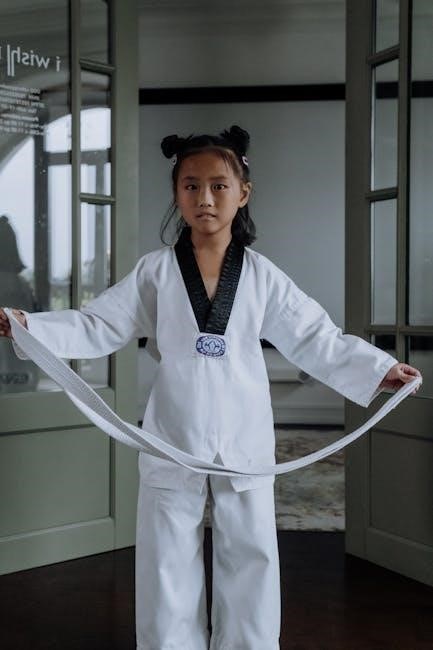
Detailed Breakdown of Forms 4-8
Forms 4-8‚ the Taeguk series‚ build upon foundational skills. PDF guides detail increasing complexity‚ introducing new techniques and combinations for advanced Taekwondo practice.
Form 4: Taeguk I Jang (The Second Step)
Taeguk I Jang represents the concept of “heaven” and is the fourth form in the WTF Taekwondo system. This form introduces more dynamic movements and a greater emphasis on balance and coordination compared to the earlier forms. Practitioners will encounter a wider range of blocks‚ punches‚ and kicks‚ requiring precise execution and focused intent.
PDF resources for Taeguk I Jang typically include detailed diagrams illustrating each movement‚ along with explanations of the proper stance‚ hand positioning‚ and kicking techniques. These guides often break down the form into sections‚ making it easier to learn and memorize. Understanding the underlying principles of each technique is crucial for effective performance.
Furthermore‚ supplemental video demonstrations are invaluable for visualizing the correct form and flow. Pay close attention to the transitions between movements and the overall rhythm of the form. Consistent practice‚ combined with careful study of PDF guides and video resources‚ will enable students to master Taeguk I Jang and progress confidently in their Taekwondo journey. It’s a significant step towards developing a strong foundation in poomsae.
Form 5: Taeguk Sam Jang (The Third Step)
Taeguk Sam Jang‚ the third form‚ embodies the principle of “lake‚” signifying fluidity and adaptability. Building upon Taeguk I Jang‚ this poomsae introduces circular movements and emphasizes the importance of maintaining a stable center of gravity while executing techniques. Students will refine their blocking skills and encounter more complex kicking combinations.
PDF guides dedicated to Taeguk Sam Jang provide a visual breakdown of each posture and movement‚ often including annotations detailing common errors and corrections. These resources are essential for understanding the proper alignment and technique required for each section of the form. Detailed diagrams help visualize the flow and transitions.
Complementing the PDF guides‚ video demonstrations offer a dynamic perspective‚ allowing students to observe the form performed by experienced practitioners. Focus on replicating the smooth‚ flowing movements and maintaining a consistent rhythm. Regular practice‚ combined with diligent study of available resources‚ will facilitate mastery of Taeguk Sam Jang and contribute to overall Taekwondo skill development.
Form 6: Taeguk Sa Jang (The Fourth Step)
Taeguk Sa Jang‚ representing the concept of “mountain‚” focuses on strength‚ stability‚ and unwavering resolve. As the fourth form in the Taeguk series‚ it demands increased power and precision in techniques‚ building upon the foundations established in previous forms. Students will encounter more challenging stances and combinations‚ requiring greater balance and coordination.
Accessing Taeguk Sa Jang PDF resources is crucial for detailed study. These guides typically present step-by-step illustrations and explanations of each movement‚ highlighting key points for proper execution. Pay close attention to the detailed diagrams illustrating hand positions‚ footwork‚ and body alignment.
Supplementing the PDF materials with video demonstrations allows for a comprehensive understanding of the form’s flow and dynamics. Observe how experienced practitioners generate power and maintain control throughout the sequence. Consistent practice‚ combined with careful analysis of both visual and textual resources‚ will enable students to effectively learn and perform Taeguk Sa Jang.
Form 7: Taeguk Oh Jang (The Fifth Step)
Taeguk Oh Jang‚ symbolizing “water‚” emphasizes fluidity‚ adaptability‚ and yielding strength. This fifth form in the Taeguk series introduces more circular movements and flowing transitions‚ demanding a refined sense of balance and control. Students will focus on techniques that mimic the characteristics of water – soft yet powerful‚ adaptable to any situation.
Locating a reliable Taeguk Oh Jang PDF is essential for accurate learning. These documents provide detailed breakdowns of each movement‚ including stance transitions‚ blocking techniques‚ and striking combinations. Carefully study the diagrams to understand the correct body mechanics and alignment.

Combining PDF study with video demonstrations is highly recommended. Observing experienced practitioners perform the form reveals the subtle nuances of movement and the proper application of power. Consistent practice‚ guided by both visual and textual resources‚ will help students master the flowing and dynamic nature of Taeguk Oh Jang.
Form 8: Taeguk Yuk Jang (The Sixth Step)
Taeguk Yuk Jang‚ representing “fire‚” is the final form in the initial Taeguk series. It embodies explosive power‚ passion‚ and upward energy. This form challenges students to execute techniques with increased speed‚ force‚ and focus‚ demanding precise control and unwavering determination. Expect dynamic kicks and powerful hand strikes.
Accessing a comprehensive Taeguk Yuk Jang PDF is crucial for understanding the form’s intricate details. These resources typically include step-by-step diagrams illustrating each movement‚ stance‚ and technique. Pay close attention to the direction of energy flow and the proper execution of blocking and striking combinations.
Supplementing PDF study with video demonstrations is invaluable. Observing skilled practitioners perform Taeguk Yuk Jang provides insights into the form’s rhythm‚ flow‚ and overall energy. Consistent practice‚ combined with careful analysis of both visual and textual materials‚ will enable students to embody the fiery spirit of this challenging form.
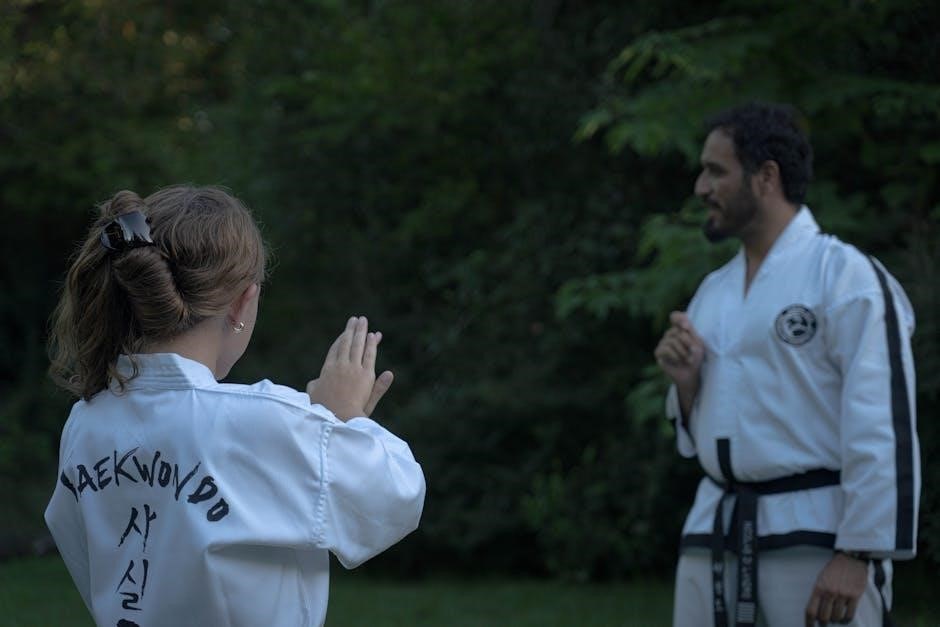
Accessing Taekwondo Forms 1-8 PDFs
Locate official WTF/GTF form PDFs through affiliated organizations and academies. Be mindful of ATA copyright restrictions‚ utilizing approved resources for accurate diagrams and instructions.
Where to Find Official WTF/GTF Form PDFs
Securing authentic WTF (World Taekwondo Federation) and GTF (Global Taekwondo Federation) form PDFs requires navigating official channels. The primary source is often through recognized Taekwondo academies directly affiliated with these governing bodies. Many schools provide students with digital copies of the forms as part of their curriculum‚ particularly for color belt students progressing through forms 1-8.
The official websites of the WTF and GTF‚ while potentially offering some resources‚ may not directly host downloadable PDFs of all forms. Instead‚ they often link to member organizations or provide information on how to find certified instructors who can supply the necessary materials. Searching for national Taekwondo federations within your country (e.g.‚ USA Taekwondo) can also lead to valuable resources and links to approved form documentation.
Be cautious of unofficial sources‚ as accuracy can vary significantly. Prioritize materials provided by qualified instructors or directly from recognized Taekwondo organizations to ensure you are learning the correct techniques and sequences. Remember that consistent‚ accurate practice is crucial for proper form execution and advancement in Taekwondo.
ATA Forms and Copyright Considerations
American Taekwondo Association (ATA) forms present a unique situation regarding PDF access and usage. Unlike WTF or GTF forms‚ ATA forms are generally copyrighted by the organization as part of their franchise system. This means finding officially sanctioned PDFs outside of an ATA-affiliated school is often difficult and potentially a copyright infringement.
ATA franchise schools receive PDF files detailing their specific forms as part of their membership package. These documents are intended for internal use by students and instructors within the school. Public distribution of these PDFs is typically prohibited. Therefore‚ obtaining ATA forms 1-8 PDFs legally usually requires enrollment in an ATA school.
It’s crucial to respect the ATA’s copyright policies. Unauthorized reproduction or distribution of their form materials is illegal and undermines the organization’s intellectual property. If you are interested in learning ATA forms‚ the best course of action is to join an ATA school and obtain the materials directly from your instructor.
Online Resources for Taekwondo Form Diagrams

While official PDFs for Taekwondo Forms 1-8 can be limited depending on the style (WTF‚ GTF‚ or ATA)‚ several online resources offer diagrams and visual aids to assist in learning. Websites dedicated to Taekwondo often feature illustrated breakdowns of each form‚ showing the sequence of movements and stances. These diagrams can be helpful supplements to video demonstrations and in-person instruction.
YouTube is a valuable resource‚ with numerous channels providing visual walkthroughs of the forms. However‚ verifying the accuracy of the information is essential‚ as interpretations can vary. Dedicated Taekwondo forums and communities also frequently share diagrams and discuss form techniques. Be cautious about downloading PDFs from unofficial sources‚ as they may be inaccurate or violate copyright.
Remember that diagrams are best used in conjunction with qualified instruction. They provide a visual reference‚ but cannot replace the guidance of a certified Taekwondo instructor who can correct your form and ensure proper technique.
Utilizing Video Demonstrations Alongside PDFs
Combining Taekwondo Form PDFs with video demonstrations is crucial for effective learning. PDFs provide a static reference for the sequence of movements‚ stances‚ and blocking techniques within Forms 1-8. However‚ they lack the dynamic element necessary to fully grasp the flow and timing. Video demonstrations‚ particularly those featuring Korean Taekwondo Masters‚ bridge this gap.
Watching videos allows students to observe the correct execution of each technique‚ including body mechanics‚ power generation‚ and transitions. Pay close attention to details like hand positions‚ footwork‚ and breathing. Use the PDF as a checklist while watching‚ pausing the video to compare your form to the demonstrated version.
Repetition is key – practice alongside the video‚ referring to the PDF for clarification. This multi-faceted approach enhances understanding and accelerates skill development. Remember‚ videos are supplemental; qualified instruction remains paramount for personalized feedback and correction.
Importance of Qualified Instruction for Form Learning
While Taekwondo Forms 1-8 PDFs and video resources are valuable tools‚ they cannot replace the guidance of a qualified instructor. Proper form execution is paramount‚ and subtle errors can develop into ingrained bad habits. A skilled instructor provides personalized feedback‚ correcting posture‚ alignment‚ and technique in real-time.

They understand the nuances of each movement‚ ensuring students grasp the underlying principles of balance‚ power‚ and focus. An instructor can also explain the historical and philosophical context of each Form‚ deepening understanding beyond mere memorization. They can tailor instruction to individual learning styles and physical capabilities.
Attempting to learn solely from PDFs and videos risks misinterpreting techniques and potentially causing injury. A qualified instructor‚ sanctioned by organizations like the U.S.A. Tae Kwon-do Federation‚ ensures safe and effective learning‚ building a strong foundation for advancement.